Showing posts with label Banking and Monetary Policy from the Perspective of Austrian Economics. Show all posts

Tuesday, February 2, 2021

The First-Round Effect May Explain the Formation of Asset-Price Bubbles, E.g. the 2000s Real Estate Booms in Spain and in Ireland

The first-round effect may also explain the formation of asset-price bubbles since they are the best evidence that prices do not rise evenly and proportionally, as in Friedman’s notion of helicopter money, but rather unevenly and disproportionately, as described by Cantillon and Austrian economists. Indeed, if money was neutral and the quantity theory of money held, asset-price bubbles—meaning the relative overvaluation of particular asset prices—would not exist. They occur due to the expansion of credit and its continuous inflow to a given asset market, in line with the Cantillon effect. Importantly, there are strong arguments that asset-price bubbles threaten financial stability and that they can lead to a deeper recession in comparison to a business cycle not accompanied by a financial bubble. Meanwhile, central banks, including the ECB, do not take into account asset-price inflation, instead focusing on price stability narrowly defined as stability of the CPI. Hence, it seems that central banks should change their stance on this matter and also monitor asset prices—otherwise, there is a risk of conducting an overly loose monetary policy, leading to imbalances in the economy and financial instability despite stable consumer prices and thus an apparent neutrality of money (as the proposals for price stabilization are based on the notion of neutrality of money). 

This is exactly what happened in the euro area in the 2000s. Although the CPI rate did not significantly exceed the ECB’s target in the first half of the decade, the loose monetary policy of the central bank (interest rates too low for too long, at least for some countries of the euro area) led to a business cycle, and real estate booms in countries of the euro area where the growth in the money supply was the highest (or where the new money mainly went), in particular Spain and Ireland.

—Arkadiusz Sieroń, “Hayek and Mises on Neutrality of Money: Implications for Monetary Policy,” in Banking and Monetary Policy from the Perspective of Austrian Economics, ed. Annette Godart-van der Kroon and Patrik Vonlanthen (Cham, CH: Springer International Publishing, 2018), 157-158.


The Term “Neutral Money” Gained Recognition in the English Language Literature through Hayek’s Publications

The neutrality of money means the lack of effects of monetary phenomena on real variables.³ There are a few different notions of neutrality of money, depending on how one defines “monetary phenomena.” Probably the most important notion, which we call “dynamic neutrality,” implies that changes in the supply of money only affect nominal variables, while real variables, such as relative prices, production, or employment, remain unaffected. Conversely, the non-neutrality of money means changes in the money supply have an impact on real phenomena.

The concept of neutrality of money is a central economic issue widely discussed from the very beginning of economics as a science. It is sufficient to mention the quantity theory of money formulated at first by Locke, which basically states that the level of prices is always in proportion to the quantity of money. It was probably formulated and believed by classical economists as a reaction against mercantilists’ inflationism, but that reaction was exaggerated and hampered the genuine development of monetary economics. The quantity theory of money is true but only from the point of view of comparative statics. One economy with twice the money supply of another but with no other differences should have twice as high a general price level. However, it does not follow that doubling the money supply only leads to doubling all prices. For the neutrality of money to hold from the dynamic perspective, several conditions must be fulfilled.

__________

³ The term “neutral money” gained recognition in the English language literature through Hayek’s publications. However, it was in use earlier among Continental economists.

⁵ According to Hayek (2008a [1935]), there are three conditions for the neutrality of money: constant total money stream, perfectly flexible prices, and long-term contracts based on a correct anticipation of future price movements.

—Arkadiusz Sieroń, “Hayek and Mises on Neutrality of Money: Implications for Monetary Policy,” in Banking and Monetary Policy from the Perspective of Austrian Economics, ed. Annette Godart-van der Kroon and Patrik Vonlanthen (Cham, CH: Springer International Publishing, 2018), 154.


Monday, April 20, 2020

How the TARGET2 Balances of the European Central Bank Worked BEFORE the European Financial and Debt Crisis

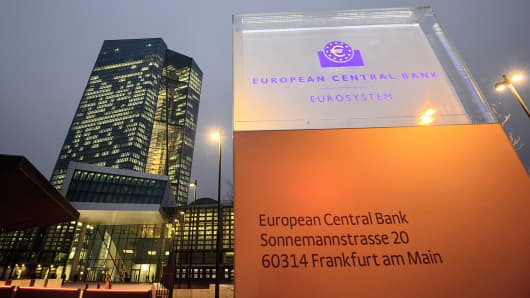
With the national central banks being part of the Eurosystem, the intra-euro area rescue measures became reflected in the TARGET2 balances of the European Central Bank. TARGET2 (Trans-European Automated Real-time Gross Settlement Express Transfer System) is a real-time gross settlement system for payments within the euro zone, which is used to clear cross-border transfers in the euro area. Before the European financial and debt crisis, the national central banks’ positions in the TARGET2 system were widely balanced, because private capital flows were matched by respective payment flows resulting from goods markets transactions. For instance, German (Greek) capital exports (capital imports) corresponded to payments receipts (payments) for German goods sales (Greek goods purchases).

—Gunther Schnabl, “The Failure of ECB Monetary Policy from a Mises-Hayek Perspective,” in Banking and Monetary Policy from the Perspective of Austrian Economics, ed. Annette Godart-van der Kroon and Patrik Vonlanthen (Cham, CH: Springer International Publishing, 2018), 140.