In a certain respect, neoclassical economics has not changed much in the past 50 years. Many of the recent “innovations” in theory simply extend the static maximizing apparatus to allegedly dynamic issues. In particular, time is still most frequently conceived in purely static terms. As such, it is analogized to space: Just as an individual may allocate portions of space (land) to certain purposes, he can also allocate portions of time to certain activities. In principle, time and perfect predictability are compatible. The dynamic conception of time, on the other hand, is time perceived as a flow of events. Implicit in this idea of a flow is that of novelty or true surprise. The individual’s experience of today’s events itself makes tomorrow’s perceptions of events different than it otherwise would be. As an individual adds to the stock of his experiences, his perspective changes and so both the present and the future are affected by the past flow of events. Flows, however, are continuous, and hence the individual’s perspective changes right up to the moment of any experience. This renders perfect prediction of the experience impossible. Since all individuals are similarly affected, and since, as we have seen, the consequences of an individual’s course of action depends on what others will do, this idea of time has implications for decision-making. Choices made in real time are thus never made with complete knowledge (either deterministic or stochastic) of their consequences. The recognition of this fact by individuals is the source of rule-following behavior and, on a social level, of the development of institutions.
—Gerald P. O’Driscoll Jr. and Mario J. Rizzo, The Economics of Time and Ignorance, Foundations of the Market Economy (London: Routledge, Taylor and Francis e-Library, 2002), 2-3.
Monday, January 6, 2020
Mises Distinguishes Between a Cash Transaction and a Credit Transaction
Acts of exchange, whether direct or indirect, can be performed either in such a way that both parties fulfill their parts of the contract at the same time, or in such a way that they fulfill them at different times. In the first case we speak of cash transactions; in the second, of credit transactions. A credit transaction is an exchange of present goods for future goads.
—Ludwig von Mises, The Theory of Money and Credit, trans. H. E. Batson (Indianapolis: Liberty Fund, 1981), 296.
In a Credit Transaction, the Possessor of Money (Useful Present Good) Exchanges It for an “I Owe You” (Future Good)
None of this discussion is meant to impugn the general practice of credit, which has an important and vital function on the free market. In a credit transaction, the possessor of money (a good useful in the present) exchanges it for an IOU [an I Owe You, a debt] payable at some future date (the IOU being a “future good”) and the interest charge reflects the higher valuation of present goods over future goods on the market. But bank notes or deposits are not credit; they are warehouse receipts, instantaneous claims to cash (e.g., gold) in the bank vaults. The debtor makes sure that he pays his debt when payment becomes due; the fractional reserve banker can never pay more than a small fraction of his outstanding liabilities.
—Murray N. Rothbard, What Has Government Done to Our Money? (Auburn, AL: Ludwig von Mises Institute, 2010), 46-47.
Money Facilitates Credit Transactions, Which Are the Exchange of Present Goods against Future Goods
The simple statement, that money is a commodity whose economic function is to facilitate the interchange of goods and services, does not satisfy those writers who are interested rather in the accumulation of material than in the increase of knowledge. Many investigators imagine that insufficient attention is devoted to the remarkable part played by money in economic life if it is merely credited with the function of being a medium of exchange; they do not think that due regard has been paid to the significance of money until they have enumerated half a dozen further “functions”—as if, in an economic order founded on the exchange of goods, there could be a more important function than that of the common medium of exchange.
After Menger’s review of the question, further discussion of the connection between the secondary functions of money and its basic function should be unnecessary. Nevertheless, certain tendencies in recent literature on money make it appear advisable to examine briefly these secondary functions—some of them are coordinated with the basic function by many writers—and to show once more that all of them can be deduced from the function of money as a common medium of exchange.
This applies in the first place to the function fulfilled by money in facilitating credit transactions. It is simplest to regard this as part of its function as medium of exchange. Credit transactions are in fact nothing but the exchange of present goods against future goods.
—Ludwig von Mises, The Theory of Money and Credit, trans. H. E. Batson (Indianapolis: Liberty Fund, 1981), 46-47.
Mises: The Distinction Between Commodity and Circulation Credit Is the Key to Understanding Banking Theories
The recent financial crisis has undermined well-established convictions and paradigms within the “mainstream” macroeconomic profession, triggering an intense search for better “analytics”, as the models dominating so far largely turned out insufficient not only in predicting the crisis, but even in explaining it. In searching for new theories attention is sometimes turned to past ideas. One of them are the monetary and business cycle theories of Ludwig von Mises, which were subsequently refined by Friedrich von Hayek and other economists of the Austrian School of Economics (ASE). This big picture overview focuses on explaining the kernel of Austrian Business Cycle Theory (ABCT), which is the distinction between the two types of credit (commodity credit and circulation credit) and how this distinction applies to two types of banking activity: negotiation of credit and issuance of credit, and how these findings are being “rediscovered” in current monetary theory. Mises (1981) emphasized 101 years ago (in 1912 his “Theory of Money and Credit” was first published) that understanding of this distinction is the key to understanding banking theories (p. 297). This lesson has been forgotten for a long time, but now is being rediscovered.
—Marcin Mrowiec, “Rediscovering Mises-Hayek Monetary and Business Cycle Theory in Light of the Current Crisis: Credit Expansion as a Source of Economic Boom and Bust,” Financial Internet Quarterly 9, no. 2 (2013): 64.
Sunday, January 5, 2020
Austrian and New Classical Schools Differ on the Homogeneity Postulate So They Produce Different Business Cycle Theories
The difference between Austrians and New Classicals as regards the appropriateness of the homogeneity postulate for agents and goods leads to a difference in their respective business cycle theories. Austrians explain such cycles in terms of coordination failures between the agents’ savings and investment decisions. These failures arise from non-neutral monetary injections in the economy, which disturb the structure of relative prices. This disturbance bring about malinvestments, culminating in distortions of the structure of production.
New Classicals, on the other hand, assume that there is ‘helicopter money’, which can be spread immediately and proportionately over the economy. From a full-information point of view, money is then neutral in a comparative-static sense. Furthermore, the homogeneity postulate for goods eliminates malinvestments. Consequently, the NCE [New Classical Economics] explains business cycles in terms of overinvestments.
—Rudy van Zijp, “Austrian and New Classical Business Cycle Theories” (PhD diss., Free University of Amsterdam, 1992), 257-258.
The Concept of “Neutral Money” Stems from 3 Fundamental Errors: Static Analysis, Assumptions, and Methodology
I showed that while mainstream economics usually posits neutrality of money in the long term, when addressing short-to-mid-term cycles, it is acknowledged that changes in money supply do have an impact on the real sphere. Different schools of economics present different views on the causes of this phenomenon. Monetarists emphasize adaptive expectations, neoclassicists point to imperfect information with rational expectations and the new Keynesians focus mostly on price rigidity.
On the other hand, the Austrian school emphasizes the case in which “the monetary injection is not distributed among individuals in exact proportion to their previous shares of money holdings” (Blaug, 1985), which is responsible for the non-neutrality of money that exists even in the long term.
The concept of neutral money in its most popular view stems from erroneously applying conclusions drawn from static analysis of two equilibrium states to dynamic market processes, accepting simplified, unrealistic assumptions and holistic methodology. It seems, therefore, that the 11th of the 13 most important issues in economics, according to Morgenstern (1972), that demand resolution —that is departure from studying aggregates like “general price level” and more attention to dynamic analysis of money in Cantillon’s spirit — still remains unresolved.
I trust that my book is a step in the direction suggested by Morgenstern.
—Arkadiusz Sieroń, Money, Inflation and Business Cycles: The Cantillon Effect and the Economy, trans. Martin Turnau, Routledge International Studies in Money and Banking (Milton Park, UK: Routledge, 2019), 11-12.
Mainstream Macroeconomics and the Keynesian Revolution Can ONLY Be Understood in Relation to Malthus’s Economics
The Keynesian Revolution, and therefore the origins of virtually all macroeconomic theory today, can only be understood in relation to Keynes’s coming across Malthus’s economic writings in 1932. In particular, it was his reading of the Malthus side of the Malthus — Ricardo correspondence, which had been unearthed in 1930 by his close associate Piero Sraffa, that turned Keynes’s mind to the possibility of demand deficiency as a cause of recession. Until that time, economists had been near unanimous in arguing that insufficient demand as a cause of recession was fallacious, and until reading the Malthus — Ricardo correspondence, this possibility had never crossed Keynes’s mind. . . .
It was Malthus, of course, who had been the leading advocate in the nineteenth century of demand deficiency as a cause of recession, and of increased levels of unproductive spending as the cure. Reading Malthus’s letter to Ricardo, and then the text of Chapter VII of Malthus’s Principles, both of which Keynes did at the end of 1932, ought to be recognized as the single most important reason why Keynes was to write what he wrote in the way that he did.
—Steven Kates, Free Market Economics: An Introduction for the General Reader (Cheltenham, UK: Edward Elgar Publishing, 2017), Kobo e-book.
Saturday, January 4, 2020
From the Very Nature of Economic Theory, Averages Can NEVER Form a Link in Its Reasoning
Yet we are doing nothing less than this if we try to establish direct causal connections between the total quantity of money, the general level of all prices and, perhaps, also the total amount of production. For none of these magnitudes as such ever exerts an influence on the decisions of individuals; yet it is on the assumption of a knowledge of the decisions of individuals that the main propositions of non-monetary economic theory are based. It is to this ‘individualistic’ method that we owe whatever under standing of economic phenomena we possess; that the modern ‘subjective’ theory has advanced beyond the classical school in its consistent use is probably its main advantage over their teaching.
If, therefore, monetary theory still attempts to establish causal relations between aggregates or general averages, this means that monetary theory lags behind the development of economics in general. In fact, neither aggregates nor averages do act upon one another, and it will never be possible to establish necessary connections of cause and effect between them as we can between individual phenomena, individual prices, etc. I would even go so far as to assert that, from the very nature of economic theory, averages can never form a link in its reasoning.
—Friedrich A. von Hayek, A Tiger by the Tail: The Keynesian Legacy of Inflation, 3rd ed., comp. Sudha R. Shenoy (London: Institute of Economic Affairs, 2009), 16-17.
Hayek on the Meaning of the Well-Known Doctrine Called the “Acceleration Principle of Derived Demand”
The significance of the results so far obtained can perhaps be made clearer if we relate them to a well-known doctrine, the so-called “acceleration principle of derived demand.” This doctrine, into the long history and the detail of which we need not enter here, essentially asserts that, since the production of any given amount of final output usually requires an amount of capital several times larger than the output produced with it during any short period (say a year), any increase in final demand will give rise to an additional demand for capital goods several times larger than that new final demand. The demand for capital goods according to this theory is the result of final demand multiplied by a given coefficient. We shall refer here to the two factors which determine this product as the “multiplicand” and the “multiplier” respectively, the former being final demand and the latter the ratio at which this final demand is transformed into demand for capital goods. (This “multiplier” with which the acceleration principle operates must, of course, not be confused with the Multiplier which plays such an important role in Mr. Keynes’ theories).
—Friedrich A. von Hayek, “Profits, Interest and Investment (1939),” in Profits, Interest and Investment and Other Essays on the Theory of Industrial Fluctuations (1939; repr., Clifton, NJ: Augustus M. Kelley Publishers, 1975), 18-19.
Keynes Tried to Do the Impossible: Reconciling Money and Equilibrium
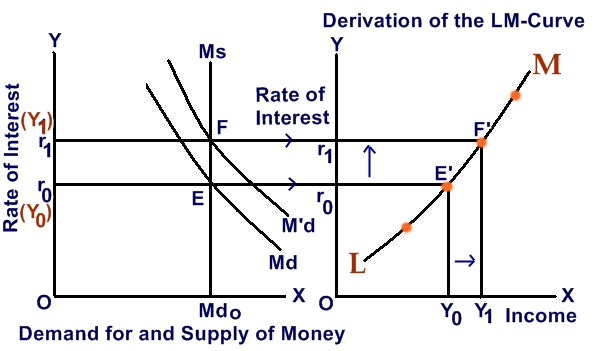
Multiplier-accelerator models had trouble dealing with money. The analysis of the cycle in terms of multiplier-accelerator interaction could be conducted entirely in real terms. Thus the role of money often came in as an afterthought. In order to accomplish that link the LM-curve had to be accounted for and that could be done by assuming that it was horizontal. As Laidler (1999) stresses, in that way one cut out any feedback from the monetary system that might disturb the smooth operation of whatever linear-difference-equation dynamics were to be analyzed. Thus even with explicit dynamics it appeared that the role of money was not so fundamental as Keynes had claimed it to be.
Kohn (1986) attributes this failure of the Keynesian revolution to a basic error in Keynes’s thinking. In his view, Keynes had tried to do what was undoable, namely to reconcile money and equilibrium. In order to explain the role of money, one needs to introduce uncertainty or specific market failures, assumptions that are incompatible with the conditions of equilibrium, which requires perfect knowledge, plan coordination or market clearing on all markets et cetera. This internal inconsistency of the GT [Keynes's General Theory] was quickly resolved by those who further developed Keynesian economics. They dropped the monetary factor and retained the assumption of equilibrium as the foundation of their work.
—Bert Tieben, The Concept of Equilibrium in Different Economic Traditions: An Historical Investigation (Cheltenham, UK: Edward Elgar Publishing, 2012), 391-392.
To Overthrow General Equilibrium Theory, Hans Mayer Attacked Indifference Curve Analysis
Mayer said mental facts, or self-observation, sufficed to establish two things. First, want satisfactions of different kinds were interdependent and, second, they were linked, not in the simultaneous manner suggested by indifference curves, but in a dynamic, causal, fashion: the relationship between wants and their satisfaction was not one of general, mutual dependence as suggested by indifference mapping, but one in which new wants emerged in time, depending on the degree to which existing desires had been satisfied. It was thus invalid to assume that all wants were present at the beginning of the “problem.” The “postulate of the law of equal marginal utility . . . becomes impossible in the real world of the psyche.” Given that it was the basis on which the theory of general equilibrium depended, if “this fundamental law of the equalization of the level of marginal utility did not hold, the whole theoretical system of equilibrium prices would lose its main support.”
—Robert Leonard, Von Neumann, Morgenstern, and the Creation of Game Theory: From Chess to Social Science, 1900-1960, Historical Perspectives on Modern Economics (New York: Cambridge University Press, 2010), 85.
Hans Mayer, a Neglected Figure in Austrian Economics, Put the Concept of Static Equilibrium on Trial
Because of the disgrace he later brought upon himself, in 1938, Hans Mayer is the neglected figure in the history of Austrian economics in the interwar period. . . .
A theorist in the tradition of Menger and von Wieser, Mayer was interested in the imputation problem. However, amongst the issues regarding which considerable discussion was devoted in his seminar in the late 1920s were those of the incorporation of time into equilibrium theory, the psychological bases of marginalist economics, and the place of mathematics in economic analysis. . . .
Mayer saw himself as an Austrian bulwark against Marginalist orthodoxy. As early as 1911, in a review of Schumpeter's Das Wesen und der Hauptinhalt der theoretischen Nationalökonomie, he criticized the use of the differential calculus in economics. He said that although the possibility of infinitesimal change was plausible in the measurement of time and space, it was inapplicable in the consideration of economic quantities: what sense did it make to speak of the satisfaction yielded by an infinitesimal portion of, say, a shoe? He stated that in the economic realm, reasoning in mathematical terms, made possible through the adoption of methods that had proven themselves in the natural sciences, marked a surrender to pure “form.” By the mid-1920s, the supposed sterility of the use of mathematics and the excessive simplification involved in reducing subjective action in time to a static, mathematical description had become essential motifs in Mayer's work. In his seminar meetings, he took his students through the early work of Cournot, the Lausanne School, and Jevons. One might say he was putting the concept of static equilibrium on trial.
—Robert Leonard, Von Neumann, Morgenstern, and the Creation of Game Theory: From Chess to Social Science, 1900-1960, Historical Perspectives on Modern Economics (New York: Cambridge University Press, 2010), 83-84.
Friday, January 3, 2020
The Schumpeterian Entrepreneur Is Disequilibrating, But the Kirznerian Entrepreneur Is Equilibrating
All this leads me to express a certain dissatisfaction with the role assigned to the entrepreneur in the Schumpeterian system. . . . Here it is enough to observe that Schumpeter's entrepreneur and the one developed here can in many ways be recognized — and, let me add, reassuringly recognized — as the same individual. But there is one important respect — if only in emphasis — in which Schumpeter's treatment differs from my own. Schumpeter's entrepreneur acts to disturb an existing equilibrium situation. Entrepreneurial activity disrupts the continuing circular flow. The entrepreneur is pictured as initiating change and as generating new opportunities. Although each burst of entrepreneurial innovation leads eventually to a new equilibrium situation, the entrepreneur is presented as a disequilibrating, rather than an equilibrating force. Economic development, which Schumpeter of course makes utterly dependent upon entrepreneurship, is “entirely foreign to what may be observed in . . . the tendency towards equilibrium.”
By contrast my own treatment of the entrepreneur emphasizes the equilibrating aspects of his role. I see the situation upon which the entrepreneurial role impinges as one of inherent disequilibrium rather than of equilibrium — as one churning with opportunities for desirable changes rather than as one of placid evenness. Although for me, too, it is only through the entrepreneur that changes can arise, I see these changes as equilibrating changes. For me the changes the entrepreneur initiates are always toward the hypothetical state of equilibrium; they are changes brought about in response to the existing pattern of mistaken decisions, a pattern characterized by missed opportunities. The entrepreneur, in my view, brings into mutual adjustment those discordant elements which resulted from prior market ignorance.
—Israel M. Kirzner, Competition and Entrepreneurship (Chicago: University of Chicago Press, 1973), 72-73.
“Capital Reversal” Creates Serious Difficulties for the Neoclassical Theory of Interest
In the course of the Cambridge debate it was the reswitching and capital reversal paradoxes which cast the deepest shadow upon the mainstream neoclassical theory of distribution. Yet, as we shall see, these paradoxes present no problem at all for the explanation of interest contained in the Misesian theory of capital and interest.
The problem posed for the neoclassical theory by the phenomenon of ‘capital reversal’ is well known. Capital reversal occurs when a change in the rate of interest is associated with a seemingly ‘perverse’ change in adopted production technique — for example, when a reduction in the interest rate implies a switch to ‘the less, not the more, time-consuming, or roundabout or capital-intensive technique’ (Yeager, 1976). The capital reversal is at least theoretically possible was conceded by major exponents of the neoclassical position in the 1960s (Saumelson, 1966; Ferguson, 1969). That this concession implies serious difficulties for the neoclassical view of interest as the supply-and-demand price of a productive service, has been emphasized by many writers.
—Israel M. Kirzner, introduction to Essays on Capital and Interest: An Austrian Perspective (Cheltenham, UK: Edward Elgar Publishing, 1996), 7.
Mises’s Redirection of Capital and Interest Theory Along Mengerian Lines Was Brutally Attacked by Knight
It was thus Mises, in his 1940 Nationalökonomie rediscovery and further development of Fetter’s pure time-preference theory of interest, who was to refine Böhm-Bawerkian theory and redirect it along Mengerian lines. In his slashing review article on Mises’s book, Knight (1941) perceptively recognized this — and saw it as grounds for dismissing Mises’s entire approach to the theory of capital and interest. In other words, Knight was attacking Mises not only because he was, like Böhm-Bawerk and Fisher, emphasizing the role of time in production (whereas for Knight the foundation of wisdom in this area consists in recognizing that ‘in a stationary economy, all production and consumption are strictly simultaneous; the waiting period is zero; there is none’: ibid., p. 420). Rather, he was attacking Mises for his ‘original and naive or absolute “Austrianism”’ (ibid., p. 422) — by which he apparently meant Mises’s Mengerianism. (This reading of Knight's attack is reinforced by his own explicit rejection of Mises’s frequent and favourable references to Menger’s conception of the ‘order’ of goods. On Knight's sweepingly dismissive attitude to this conception of Menger’s, see also his highly critical introduction to the 1950 English edition of Menger’s 1871 Grundsätze (p. 25).) For Knight, Mises’s cardinal sin was not so much is emphasis on the role of time per se, as his denial of primary explanatory significance to the objective productivity of time.
—Israel M. Kirzner, introduction to Essays on Capital and Interest: An Austrian Perspective (Cheltenham, UK: Edward Elgar Publishing, 1996), 4.
Thursday, January 2, 2020
Heterogeneity of Capital Means Heterogeneity in Use; Heterogeneity in Use Implies Multiple Specificity
All capital resources are heterogeneous. The heterogeneity which matters is here, of course, not physical heterogeneity, but heterogeneity in use. Even if, at some future date, some miraculous substance were invented, a very light metal perhaps, which it was found profitable to substitute for all steel, wood, copper, etc., so that all capital equipment were to be made from it, this would in no way affect our problem. The real economic significance of the heterogeneity of capital lies in the fact that each capital good can only be used for a limited number of purposes. We shall speak of the multiple specificity of capital goods.
—Ludwig M. Lachmann, Capital and Its Structure (Kansas City: Sheed Andrews and McMeel, 1978), 2.
Hayek Is Famous for Having Been a Pioneer in the Idea of Intertemporal Equilibrium
In his famous 1933 Copenhagen lecture, Hayek pronounced “the fundamental problem of all economic theory,” to be “the question of the significance of the concept of equilibrium and its relevance to the explanation of a process which takes place in time” (Hayek, [1933] 1939b, p. 138). There can be no doubt that this “fundamental problem” was never far from Hayek’s concern as an economic theorist (and of course this is true for most economic theorists, of most schools of thought). Even when Hayek was to criticize “modern economists” for their “perhaps excessive preoccupation with the conditions of a hypothetical state of stationary equilibrium” (Hayek, [1935] 1949a, p. 167), the relevance of the equilibrium concept and its centrality for economic understanding was not in question. Hayek is famous for having been a pioneer in the idea of intertemporal equilibrium (Hayek, [1928] 1994), and even after he expressed his impatience with the profession’s preoccupation with the equilibrium concept, he considered intertemporal equilibrium to be a central building block for his own system of understanding. In regard to the coordination problem, we note that Hayek did not object so much to the professional attention to what is called the state of “competitive equilibrium” (in which “the data for the different individuals are fully adjusted to each other”), as to its failure to explain “the nature of the process by which the data are thus adjusted” (Hayek, 1949a, p. 94). We have already noticed how important for Hayek’s work on coordination, was his pathbreaking reinterpretation of equilibrium in terms of the mutual compatibility of plans. Our purpose in identifying “equilibrium” as an important theme in Hayek’s work is not to throw doubt on the importance for Hayek of the plan-coordination idea; it is simply to take note of the separateness of these ideas. To interpret equilibrium as expressing plan compatibility is not quite the same thing as to replace the role of equilibrium itself in economic understanding, by that of plan-compatibility.
—Israel M. Kirzner, “Hedgehog or Fox? Hayek and the Idea of Plan-Coordination,” in The Driving Force of the Market: Essays in Austrian Economics, Foundations of the Market Economy (London: Routledge, Taylor and Francis e-Library, 2003), 192-193.
In Asset Markets, “Big Players” Induce Herding Since Traders Trade with Other People's Money
The trouble with discretionary market interventions is not that they come from government but rather that government is a Big Player. Bigness does not a Big Player make, but it helps. To be a Big Player it is not enough to be able to influence the market, to be largely immune from competitive pressures, or even to meet both conditions. A Big Player is anyone who habitually exercises discretionary power to influence the market while himself remaining wholly or largely immune from the discipline of profit and loss. Finance ministers and central bankers are paradigmatic Big Players, but only when exercising discretionary power. Private actors, too, may be Big Players. Each seller in oligopoly is one, which is what makes modeling oligopoly so difficult.
Our claim may seem unreasonable. Surely the authorities exercising discretion have an objective function or reaction function. Cannot such a function be set forth with just as much (or little) confidence as the equations describing underlying conditions of demand and supply? No: the concept of objective or reaction function cannot be put to good use.
In exercising discretion, a central bank commits itself to nothing but what it deems best in view of information available at the time of each decision, interpreting and weighing each bit of information as it then chooses. The variables in the bank’s reaction function and the weights given to each, as well as the function’s mathematical form, may thus change from decision to decision. Were changes in the function ruled out, the bank would be following a rule instead of exercising discretion. The econometric problem of identifying a changeable reaction function is necessarily insuperable, and assuming its existence is useless for guiding expectations.
We may put the matter in another way. A decisionmaker employing discretion learns over time. ‘‘Real’’ learning implies more than the accretion of information; it implies a change in knowledge and in how news is ‘‘framed,’’ ‘‘filtered,’’ or interpreted. Real people are always somewhat surprising. Just as we would not expect to model our loved ones mathematically, so we should not expect to succeed in modeling central-bank presidents. The behavior of Big Players, to paraphrase Keynes, affords no scientific basis whatever on which to form any calculable reaction function.We simply do not know (Keynes, 1973).
In asset markets, Big Players induce herding. Many of the traders in an asset market are trading with other people’s money (Scharfstein and Stein, 1990). Good and bad trades affect their reputations as hired hands. Reputation typically hinges on relative performance. If most S&Ls are failing, including yours, you are not considered a bad banker, just the unlucky victim of an industry crisis. When you go along with the common wisdom and things go bad, you can share the blame with everyone else and leave your relative performance still looking pretty good. If things go well instead, so much the better. The really dangerous thing is to defy common wisdom and lose; your reputation is shot and you must look for a new line of work (Scharfstein and Stein, 1990).
—Roger Koppl and Leland B. Yeager, “Big Players and Herding in Asset Markets: The Case of the Russian Ruble,” Explorations in Economic History 33, no. 3 (July 1996): 368-369).
Policy Uncertainty Creates a Low Level of Confidence Leading to a Prolonging of the Economic Slump
My ‘Austrian’ explanation of the long slump will be that policy uncertainty has created a low state of confidence and a corresponding slump in investment. The ‘state of confidence’ has a long history in economics, as I will show. Economists today are more likely to speak of ‘animal spirits’ than ‘confidence’ to identify the same supposed dispositions, expectations and emotions of business investors. Whatever the label, it is an important topic. And yet there has been relatively little attention to the theory of the state of confidence. Drawing on Higgs (1997) and Koppl (2002), I will outline a theory of confidence that explains the long slump, a theory that fills in the something that has inhibited economic adjustment after the boom.
In brief, the explanation is as follows. Interventionist policies create uncertainty, raise the costs of financial intermediation and discourage investment. I might almost say that the problem is not that the government has done too little, but that it has done too much. That way of putting it, though, may seem to suggest that I am an ‘austerian’ who wants to heat up the economy by freezing government spending. The problem, however, is not the level of government spending. The problem is changing rules, uncertain regulations, shifting Fed policy. The problem is the variability and unpredictability of government economic policy.
In the theory I lay out below, the state of confidence is more likely to be arbitrary and self-referencing the more precarious our knowledge of the future. Investor expectations are never certain (by their nature) and never a total blank. Where we are between the poles of ignorance and prescience depends on the policy regime affecting investors. I will emphasise two aspects of the policy regime: whether the rules of the game are uncertain and whether there is ‘Big Player’ influence.
—Roger Koppl, From Crisis to Confidence: Macroeconomics after the Crash, Hobart Paper 175 (London: Institute of Economic Affairs, 2014), 13-14.
The “Lachmann Problem” Is the Problem of Building a Radically Subjectivist Theory of Expectations
What produced this great personal achievement of Lachmann? It was not, I think, his solution to any economic problem, but his identification of one. The problem Lachmann drew our attention to was the need for a theory of expectations in which each person’s actions are animated by the spontaneous activity of a free human mind. I will call the problem of building a radically subjectivist theory of expectations, the ‘Lachmann problem.’
It is not obvious how such a thing is to be done. How can I let the agents of my model be free and still predict anything—even within the model! If we take seriously the ‘subjectivism of active minds,’ we seem to fall into the horrible pit of open possibility with no ladder upon which to get out. This, we have been told, is nihilism.
I think there is a way out. We can combine the radical subjectivist attention to human thoughts with a more ‘objective’ understanding of the evolution of rule-governed action. Doing so may permit us to correlate observable market conditions with certain properties of economic expectations. It may help us learn when economic expectations will be more prescient and when less. It may help us learn when markets are driven mostly by fundamentals and when they are more subject to fads and fashion. To anticipate, my proposal for solving the Lachmann problem puts Schutz and Hayek together. (Alfred Schutz was a sociologist notable for his use of Husserl’s phenomenology. F.A.Hayek, of course, was one of the leading figures of Austrian economics.)
—Roger Koppl, “Lachmann on the Subjectivism of Active Minds,” in Subjectivism and Economic Analysis: Essays in Memory of Ludwig M. Lachmann, ed. Roger Koppl and Gary Mongiovi, Routledge Frontiers of Political Economy (London: Routledge, Taylor and Francis e-Library, 2003), 61-62.
Wednesday, January 1, 2020
“Complementarity” Is of the Essence of Capital Use; the Entrepreneur Has to Find the “Optimum Combination”
It is hard to imagine any capital resource which by itself, operated by human labour but without the use of other capital resources, could turn out any output at all. For most purposes capital goods have to be used jointly. Complementarity is of the essence of capital use. But the heterogeneous capital resources do not lend themselves to combination in any arbitrary fashion. For any given number of them only certain modes of complementarity are technically possible, and only a few of these are economically significant. It is among the latter that the entrepreneur has to find the ‘optimum combination.’ The ‘best’ mode of complementarity is thus not a ‘datum.’ It is in no way ‘given’ to the entrepreneur who, on the contrary, as a rule has to spend a good deal of time and effort in finding out what it is. Even where he succeeds quickly he will not enjoy his achievement for long, as sooner or later circumstances will begin to change again.
—Ludwig M. Lachmann, Capital and Its Structure (Kansas City: Sheed Andrews and McMeel, 1978), 3.
There Are at Least 7 Different Approaches to “Equilibrium” with Additional Dimensions to Consider
A term which has so many meanings that we never know what its users are talking about should be either dropped from the vocabulary of the scholar or “purified” of confusing connotations. (Machlup 1958)The continuing use of the word “equilibrium” by different people to mean different things justifies yet another brief examination. No pretense, however, is made at completeness.
I can think of at least seven different approaches to equilibrium. These are not mutually exclusive and are, indeed, related in important ways:
- equilibrium as a balance of forces
- equilibrium as a state of rest (a stationary state)
- equilibrium as a state of uniform movement (a steady state — of which 2 is a special case)
- equilibrium as a constrained maximum
- equilibrium as an optimum
- equilibrium as rational action
- equilibrium as a situation of consistent plans.
In each case at least two dimensions can be identified. Equilibrium can relate to the entire economy (general equilibrium) or to a subset of the economy (partial equilibrium) or to the individual. Equilibrium can be considered for a single all-encompassing period (static equilibrium), or for a succession of self-contained periods (temporary equilibrium) or for a succession of related sub-periods (intertemporal equilibrium).
—Peter Lewin, Capital in Disequilibrium: The Role of Capital in a Changing World, 2nd ed. (Auburn, AL: Ludwig von Mises Institute, 2011), 15-16.
Human Action Implies a Rejection of the Notion of Economic Equilibrium as an End-State
There is a close relationship between the Austrian conception of economic equilibrium and the key methodological aspect of this school. This is the notion that economics is a science of human action.
Mises (1949) defined human action as ‘conscious or purposeful behaviour’. He rejected the notion that economic individuals are ‘automatons’ who passively react to given means and given ends. Take the example of a rational agent who maximizes utility subject to constraints. The outcome of this maximization process is completely determinate given that one knows the objective function and the constraining conditions. The Austrians do not consider this type of choice-making meaningful, purposeful behaviour because it lacks a distinctive human element. Anyone facing the same objective function and constraints would make the same decision, a rare condition for people of flesh and blood. The notion of human action gives a much richer portrait of human existence. It assumes that people select their own ends and choose means to attain those ends. For an individual to act is a personal affair and touches the heart of being human. In the words of Mises: ‘Action is the essence of his nature and existence, his means of preserving his life and raising himself above the level of animals and plants’ (ibid., 18). What makes action human is the fact that it is goal-oriented or purposeful behaviour. People are conscious beings and they use their brain to imagine a future in which life is better. Their actions are directed at making that dream become reality and although they know that disappointments are a fact of life, they will not stop trying. Man ‘is not only homo sapiens, but no less homo agens’ (ibid., 14) which is governed by the lifelong quest to improve his living conditions, whatever disappointments and setbacks he may find on his path.
One of the key tenets of the Austrian tradition is that human action implies a rejection of the notion of economic equilibrium as an end-state. When equilibrium means that every participant in a market realizes his plans, or in neoclassical terminology ‘maximizes utility’, no one has an incentive to change his or her behaviour. This is the end of economic activity and the negation of human action. ‘A man perfectly content with the state of affairs would have no incentive to change things. He would have neither wishes nor desires; he would be perfectly happy. He would not act; he would simple live free from care’ (Mises 1949, 13).
—Bert Tieben, The Concept of Equilibrium in Different Economic Traditions: An Historical Investigation (Cheltenham, UK: Edward Elgar Publishing, 2012), 302-303.
“Genetic-Causal Economics” Is the Method of Reducing Aggregates to Statements about Individual Choices
As is often true, Lachmann's real economic education — his detailed inquiry into the problems of the discipline — began after he met the requirements for his doctorate. In addition to the study of Pareto he and Kauder began work on Hayek's Monetary Theory and the Trade Cycle (1933) and Prices and Production (1931). During these sessions Kauder stressed the importance of subjectivism, especially subjective opportunity cost as the key concept in economic analysis. Lachmann also returned to the study of genetic-causal economics, the term of Werner Sombart and Hans Mayer for the Austrian method of reducing aggregates to statements about individual choices.
By this time, Lachmann's basic theoretical formulation, with the possible exception of the role of changing expectations in economic life, had been worked out. The foundations of Lachmann's theoretical structure were (1) a firm belief in the subjective theory of value and the related concept that the economic cost of an action always refers to a forgone opportunity; (2) a preference for the genetic-causal method of inquiry in contrast to the mathematical-functional approach of the Lausanne school; (3) a familiarity with the verstehende methode as espoused by Max Weber (an aspect of Lachmann's work that lay dormant for the next twenty years); and (4) an acceptance of the Mises-Hayek theory as a cogent explanation of the trade cycle.
—Walter E. Grinder, introduction to Capital, Expectations, and the Market Process: Essays on the Theory of the Market Process, by Ludwig M. Lachmann (Kansas City: Sheed Andrews and McMeel, 1977), 8-9.
Subscribe to:
Posts (Atom)