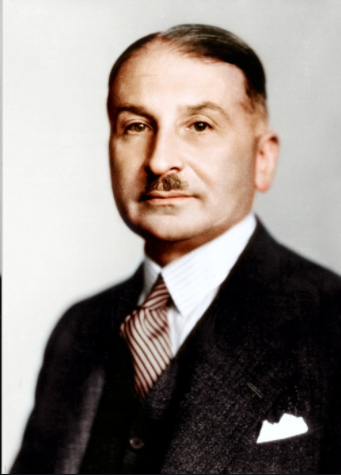
—Gottfried von Haberler, “Between Mises and Keynes: An Interview with Gottfried von Haberler,” Austrian Economics Newsletter 20, no. 1 (Spring 2000), https://mises.org/library/between-mises-and-keynes-interview-gottfried-von-haberler (accessed January 28, 2020).
Tuesday, January 28, 2020
The Key Problem with Rational Expectations Is They Assume Everyone Is an Accomplished Econometrician and a 100% Monetarist
Austrian Economics Newsletter: What do you see as the fundamental problem with the rational Expectations literature?
Gottfried von Haberler: Oh, they go much too far. They are saying, for instance, that monetary policy cannot have any effect because people immediately anticipate it; that, when they read in the paper that the money supply has gone up, everyone concludes that the price level is going up, and everyone takes immediate actions which make the effect nugatory. So they, in effect, assume that everybody is an accomplished econometrician, and a one hundred percent monetarist, which I think is simply not so.
There Is Very Little Economic Content in Much of Modern Economics; What They Are Doing Is Engineering and Applied Mathematics
Buchanan has also long been considered a proponent of the Austrian view of the market process. In this regard he is more than just a “fellow traveler”; his work has played an important role in helping to distinguish between the theory of the market as a process and the alternative, neoclassical theory of competitive equilibrium. Thus, in addition to his seminal work on subjective cost theory, Buchanan has helped clarify the Austrian view of the market as a process.
In his 1963 presidential address to the Southern Economic Association, Buchanan explained how the economics profession was apparently being led astray by its focus on the “theory of resource allocation.” He forcefully argued that the standard neoclassical definition of economics as the study of the allocation of scarce mean among competing ends “has served to retard, rather than advance scientific progress.” The reason for this, according to Buchanan, is that there is very little economic content in much of modern economics. What neoclassical economics, all too often involves is a computation problem, the computation of equilibrium prices, for example which “to the subjectivist, [seems] an absurd exercise.”
A good example is the work of Nobel Laureate Tjalling Koopmans, who began his career by working out the optimal allocation of a set of tankers carrying oil across the Atlantic during World War II. Buchanan properly labels such work as engineering, not economics, and claims that he must have been “a confirmed subjectivist long before I realized what I was because I recall thinking in 1946, when Koopmans was lecturing… at the University of Chicago, that there seemed to be absolutely no economic content in what he was doing….”
Buchanan has attempted to persuade the economics profession to abandon its fixation on allocation problems per se, for “if there is really nothing more to economics than this, we had as well turned it all over to the applied mathematicians.” This does appear to be the direction the profession has been heading; for “developments of note... during the past two decades consist largely of improvements in ... computing techniques, in the mathematics of social engineering.”
Instead of becoming weakly-trained mathematicians (at least by the standards of professional mathematicians), Buchanan suggested replacing the theory of resource allocation with the theory of markets.
—Thomas J. DiLorenzo and Walter E. Block, introduction to An Austro-Libertarian Critique of Public Choice, Economy and Society (New York: Addleton Academic Publishers, 2016), Kindle e-book.
In his 1963 presidential address to the Southern Economic Association, Buchanan explained how the economics profession was apparently being led astray by its focus on the “theory of resource allocation.” He forcefully argued that the standard neoclassical definition of economics as the study of the allocation of scarce mean among competing ends “has served to retard, rather than advance scientific progress.” The reason for this, according to Buchanan, is that there is very little economic content in much of modern economics. What neoclassical economics, all too often involves is a computation problem, the computation of equilibrium prices, for example which “to the subjectivist, [seems] an absurd exercise.”
A good example is the work of Nobel Laureate Tjalling Koopmans, who began his career by working out the optimal allocation of a set of tankers carrying oil across the Atlantic during World War II. Buchanan properly labels such work as engineering, not economics, and claims that he must have been “a confirmed subjectivist long before I realized what I was because I recall thinking in 1946, when Koopmans was lecturing… at the University of Chicago, that there seemed to be absolutely no economic content in what he was doing….”
Buchanan has attempted to persuade the economics profession to abandon its fixation on allocation problems per se, for “if there is really nothing more to economics than this, we had as well turned it all over to the applied mathematicians.” This does appear to be the direction the profession has been heading; for “developments of note... during the past two decades consist largely of improvements in ... computing techniques, in the mathematics of social engineering.”
Instead of becoming weakly-trained mathematicians (at least by the standards of professional mathematicians), Buchanan suggested replacing the theory of resource allocation with the theory of markets.
—Thomas J. DiLorenzo and Walter E. Block, introduction to An Austro-Libertarian Critique of Public Choice, Economy and Society (New York: Addleton Academic Publishers, 2016), Kindle e-book.
The Essence of Say's Law of Markets Is: Unless We First Produce We Cannot Consume; Unless We First Supply We Cannot Demand
The more complex the network of exchange, the more difficult the direct barter of goods one for another. Rather than be frustrated and disappointed in not being able to directly find trading partners who want the goods they have for sale, people start using some commodity as a medium of exchange. They first trade what they have produced for a particular commodity and then use that commodity to buy the things they desire from others. When that commodity becomes widely accepted and generally used by most, if not all, transactors in the market, it becomes the money-good.
It should be clear that even though all transactions are carried out through the medium of money, it is still, ultimately, goods that trade for goods. The cobbler makes shoes and sells them for money to those who desire footwear. The cobbler then uses the money he has earned to buy the food he wants to eat. But he cannot buy that food unless he has first earned a certain sum of money by selling a particular quantity of shoes. In the end, his supply of shoes has been the means for him to demand a certain amount of food.
This, in essence, is the meaning of Say’s Law. The nineteenth-century French economist Jean-Baptiste Say called it “the law of markets”: that is, unless we first produce we cannot consume; unless we first supply we cannot demand. But how much of our supply others are willing to take is dependent on the price at which we offer it to them.
—Richard M. Ebeling, “The Myth of Global Gluts and the Reality of Market Change,” in Austrian Economics and Public Policy: Restoring Freedom and Prosperity (Fairfax, VA: The Future of Freedom Foundation, 2016), Kindle e-book.
It should be clear that even though all transactions are carried out through the medium of money, it is still, ultimately, goods that trade for goods. The cobbler makes shoes and sells them for money to those who desire footwear. The cobbler then uses the money he has earned to buy the food he wants to eat. But he cannot buy that food unless he has first earned a certain sum of money by selling a particular quantity of shoes. In the end, his supply of shoes has been the means for him to demand a certain amount of food.
This, in essence, is the meaning of Say’s Law. The nineteenth-century French economist Jean-Baptiste Say called it “the law of markets”: that is, unless we first produce we cannot consume; unless we first supply we cannot demand. But how much of our supply others are willing to take is dependent on the price at which we offer it to them.
—Richard M. Ebeling, “The Myth of Global Gluts and the Reality of Market Change,” in Austrian Economics and Public Policy: Restoring Freedom and Prosperity (Fairfax, VA: The Future of Freedom Foundation, 2016), Kindle e-book.
Monday, January 27, 2020
Eugen von Böhm-Bawerk v. Keynes on Savings: An Economically Advanced Nation Does NOT Engage in Hoarding
But then why teach the paradox of thrift at all? Not only is it historically unproved, but it is fundamentally flawed. The problem is that Keynesians treat savings as if it disappears from the economy, that it is simply hoarded or left languishing in bank vaults, uninvested. In reality, saving is simply another form of spending, not on current consumption, but on future consumption. The Keynesians stress only the negative side of saving, the sacrifice of current consumption, while ignoring the positive side, the investment in productive enterprise. The Austrian economist Eugen Böhm-Bawerk stressed the positive side of saving: “For an economically advanced nation does not engage in hoarding, but invests its savings. It buys securities, it deposits its money at interest in savings banks or commercial banks, puts it out on loan, etc.” (1959 [1884], 113).
—Mark Skousen, The Big Three in Economics: Adam Smith, Karl Marx and John Maynard Keynes (Armonk, NY: M. E. Sharpe, 2007), 179-180.
GO Is a Supply-Side Statistic Reflecting Say’s Law While GDP Is a Demand-Side Statistic Reflecting Keynes’s Law
I consider the adoption of Gross Output on equal footing with GDP as perhaps the most significant advance in national income accounting since World War II. Steve Hanke says GO is a reflection of Say’s law, a supply-side statistic, while GDP is a symbol of Keynes’s law, a demand-side number (Hanke 2014). The difference is stark. If you use supply-side GO as the proper measure of economic activity, business investment is the most important sector. But if you rely on Keynesian GDP, consumer spending and government stimulus are the most important factors. The rise of GO may also signify a second round of debates between Hayek and Keynes, with GO representing the Austrian perspective (the stages of production), and GDP representing the Keynesian perspective (final effective demand).
—Mark Skousen, introduction to the new revised edition of The Structure of Production, new rev. ed. (New York: New York University Press, 2015), xvi.
One Must Be Free to Sell Property If the Information Necessary for the Market to Operate Is to be Created
We cannot overlook the fact that when Lionel Robbins was writing his 1934 book, The Great Depression, he took the opportunity, a year before Hayek wrote on the subject, to make some brief critical comments on the proposals for competitive socialism. According to Robbins, it is not enough for managers in the socialist system to try to “play” at competition and “compete” with each other when buying and selling their products, as if they were acting in a capitalist system. He feels that such proposals involve a simplistic conception of the economic system, as if it were a static system in which prices and all other information were generated ipso facto, in an objective manner, by the force of consumer demand.
In contrast, Robbins stresses that in the real world, tastes, technology, resources, and in general, all knowledge is in a process of continual change, and therefore, “the entrepreneur must be at liberty to withdraw his capital altogether from one line of production, sell his plant and his stocks and go into other lines. He must be at liberty to break up the administrative unit”. In short, one must be free to sell property if the information necessary for the market to operate is to be created, and this is clearly incompatible with public ownership of the means of production and the centralized control of the economic system which it ultimately entails. Hence, we see that along with the arguments against the computational, or purely algebraic, solution discussed earlier, Robbins offers a series of comments on “artificial competition”, and though they are brief, they are not altogether off-base.
—Jesús Huerta de Soto, Socialism, Economic Calculation and Entrepreneurship, trans. Melinda Stroup, New Thinking in Political Economy (Cheltenham, UK: Edward Elgar Publishing, 2010), 183-184.
In contrast, Robbins stresses that in the real world, tastes, technology, resources, and in general, all knowledge is in a process of continual change, and therefore, “the entrepreneur must be at liberty to withdraw his capital altogether from one line of production, sell his plant and his stocks and go into other lines. He must be at liberty to break up the administrative unit”. In short, one must be free to sell property if the information necessary for the market to operate is to be created, and this is clearly incompatible with public ownership of the means of production and the centralized control of the economic system which it ultimately entails. Hence, we see that along with the arguments against the computational, or purely algebraic, solution discussed earlier, Robbins offers a series of comments on “artificial competition”, and though they are brief, they are not altogether off-base.
—Jesús Huerta de Soto, Socialism, Economic Calculation and Entrepreneurship, trans. Melinda Stroup, New Thinking in Political Economy (Cheltenham, UK: Edward Elgar Publishing, 2010), 183-184.
Sunday, January 26, 2020
Oskar Lange's “Two Pages of Fiction” (His “Refutation” of Mises over Socialist Calculation) Is Founded on the Illiterate Expression “Given Data”
There is endless repetition of the claim that Professor Oskar Lange in 1936 refuted the contention advanced in 1921 by Ludwig von Mises that ‘economic calculation is impossible in a socialist society.’ The claim rests wholly on theoretical argument by Oskar Lange in little more than two pages, 59 to 61, in the most widely known reprint of his original essay, with Fred M. Taylor, On the Economic Theory of Socialism (ed. B. E. Lippincott, University of Minnesota Press, 1938). It will be timely to analyse this argument clause by clause. We shall here indent Lange’s successive assertions with the crucial terms in italics, and examine their validity and bearing one by one. . . .
Lange continues:
Lange continues:
The economic problem is a problem of choice between alternatives. To solve the problem three data are needed; (1) a preference scale which guides the acts of choice; (2) knowledge of the ‘terms on which alternatives are offered’; and (3) knowledge of the amount of resources available. Those three data being given, the problem of choice is soluble.The illiterate expression ‘given data’ constantly recurs in Lange. It appears to have an irresistable attraction to mathematical economists because it doubly assures them that they know what they do not know. It seems to bewitch them into making assertions about the real world for which they have no empirical justification whatever. On the confusion supported by this pleonasm the whole of Lange’s ‘refutation’ of Mises’ argument (and most of the theory of resource allocation descending from it) is based. Note the following:
. . . it is obvious that a socialist economy may regard the data under 1 and 3 as given, at least in as great a degree as they are given in a market economy.—F. A. Hayek, “Two Pages of Fiction: The Impossibility of Socialist Calculation,” Economic Affairs 2, no. 3 (April 1982): 135-136.
Saturday, January 25, 2020
Böhm-Bawerk Sought a Universal Notion of Capital, but Menger Developed a Historically Specific View with Microeconomic Foundations
Just as in their respective treatments of the goods-character of goodwill, Menger’s sympathy for the everyday practices of economic agents and Böhm-Bawerk’s lack of concern for them are evident in their competing capital concepts. Menger’s respect for the lessons of ‘experience’ (a word he used tirelessly) led him to restrict capital to its actual role as diverse possessions which generate private incomes in a monetary economy (capital in the acquisitive sense). Böhm-Bawerk recognized the dual meaning of capital—that is to say, capital in the acquisitive sense, and capital in the technical sense—as an instrument of production. However, the centrality of the technical element in his choice of social capital as a guiding conception did not lead him beyond capital as an aggregate of produced goods with a durable foundation. He sought a universal notion, whereas Menger developed a view as to the content of capital historically specific to private ownership and entrepreneurial economizing in a monetary economy. In such an economy, entrepreneurial behaviour was not merely perfunctory or secondary to the technical dictates of the so-called Böhm-Bawerkian ‘instruments of production’. Menger’s theories of capital and money had microeconomic foundations: uncertain needs were served by holding cash balances, including speculative balances. The use of money cannot be precisely scheduled; it acts as a stock against the disappointment of individuals’ plans in uncertain conditions. Indeed, ‘Menger again and again stresses that demand is fickle, that it changes in unpredictable ways and that such changes bring about economic frictions’ (Streissler 1973). It is precisely in these conditions of uncertainty generated through demand fluctuations that the concept of capital in the acquisitive sense is formed in the minds of Menger’s entrepreneurs.
—A. M. Endres, Neoclassical Microeconomic Theory: The Founding Austrian Version, Foundations of the Market Economy (London: Routledge, Taylor and Francis e-Library, 2002), 171-172.
The Consumption-Theory of Time Preference Integrates the Theory of Capital and Interest into the General Theory of Prices
Let us highlight the significance of this explanation within the overall theoretical framework of Misesian economics. Consumption here appears as the root of all economic phenomena. Carl Menger and his disciples had argued that consumer choices directly determine the prices of consumers’ goods, and that indirectly they also determine the prices of producers’ goods. Now time preference, too, and with it the phenomena of capital and interest appear to be rooted in consumption. The great attraction of this explanation (at least from Mises’s point of view) was that it did not stress any psychological dispositions of man, but relied on the fundamental fact that there can be no human action without consumption. The consumption-theory of time preference thus seamlessly integrates the theory of capital and interest into the general theory of prices. In the field of interest—as in the broader market process—the consumer is sovereign.
—Jörg Guido Hülsmann, Mises: The Last Knight of Liberalism (Auburn, AL: Ludwig von Mises Institute, 2007), 779.
Time Preference Is Only the Proximate Cause of Interest; the Ultimate Cause Was the Necessity of Consumption
Like Böhm-Bawerk, Mises believed that time preference was only the proximate cause of interest. But rather than seeing the ultimate cause in certain psychological dispositions of the human being, he followed Frank Fetter and Franz Cuhel in arguing that the ultimate cause was the necessity of consumption. The fact is that human beings cannot survive if they do not consume. Hence there must be some time preference in human action or the human race would perish. This does not mean that time preference is the only factor determining human actions. It means that in order to survive, human beings must at some point prefer shorter production processes to longer ones, even though the longer ones would be more physically productive.
Mises argued that one would always choose the longest production process if one could disregard the need for survival through time. It is the need to survive that prompts the acting person also to consider the passage of time and to prefer, at some point, sooner results to later ones.
—Jörg Guido Hülsmann, Mises: The Last Knight of Liberalism (Auburn, AL: Ludwig von Mises Institute, 2007), 778.
Mises argued that one would always choose the longest production process if one could disregard the need for survival through time. It is the need to survive that prompts the acting person also to consider the passage of time and to prefer, at some point, sooner results to later ones.
—Jörg Guido Hülsmann, Mises: The Last Knight of Liberalism (Auburn, AL: Ludwig von Mises Institute, 2007), 778.
Friday, January 24, 2020
Time-Preference Is NOT Always Preference for Present Goods As Compared with Future Goods
It should, however, be carefully observed that time-preference is not always preference for present goods as compared with future goods. We sometimes, indeed very frequently, prefer to have certain things in the future. After any meal, the present use of the remaining food in the pantry, the cellar, the granary, is worth less than its possibility of future uses, some of which are a few hours, others a few days, others perhaps weeks distant. The changes of the seasons with their effects on the abundance of plant and animal life cause a pretty regular cycle of valuations. When the crops are harvested in the fall, the farmer, while setting apart some of the fruits of the field to provide for the present nourishment of himself and family, yet stores up the rest for later use. His immediate needs are over-supplied, and his anticipated future needs induce him to save. In a fishing tribe after a great haul of fish a present fish is worth less than the certainty of a fish six months later when fish will be scarce. After a successful buffalo hunt, when all the members of the tribe are sated with meat, present meat is worth less than the chance of an equal amount of meat any time for nearly a year. Ice has less value in winter both because the need for ice in refrigerators is less, and because ice is more plentiful. In January one would gladly exchange a larger amount of present ice for a smaller amount to be delivered the following July. Crops of fruit, vegetables, etc., are on the average worth less per unit at the moment they are gathered than at any other time in the year until the next crop is due.
—Frank A. Fetter, Economics, vol. 1, Economic Principles (1915; repr., New York: The Century Co., 1928), 237-238.
Capital-Based Growth Is Fundamental to All Austrian Macroeconomics
One of the distinguishing characteristics of the Austrian school
throughout the development of modern macroeconomics was
its structure of production framework and capital theory. Building
on Menger’s (2007 [1871]) insights regarding the categorization
of goods as “higher order” or “lower order,” Böhm-Bawerk (1930
[1889]) presented a structure of production theory based upon
the roundaboutness of production processes and recognized time
preference as a factor in determining the interest rate and economic
growth. Mises (2009 [1912]) used these insights among others to
sketch a capital and monetary based business cycle theory and later
contributed to the pure-time-preference theory of interest (Mises, 2008
[1949]). Hayek (2008 [1931]) made notable contributions to capital and business cycle theory, including a graphical representation of
the structure of production that could show both sustainable and
unsustainable growth, which he subsequently attempted to further improve (Hayek, 2012 [1941]). Rothbard (2009 [1962]) synthesized
this entire system traceable to Böhm-Bawerk through his “development of a capital and interest theory that integrated the temporal production-structure analysis of Knut Wicksell and [F.A] Hayek
with the pure-time-preference theory expounded by Frank A. Fetter
and Ludwig von Mises” (Salerno, 2009, p. xxvii). Using the ideas of earlier Austrian theorists as well as adding his own contributions,
Rothbard presented the relationship between the interest rate and
the proportion between consumption and investment in the clearest
and most logically deduced manner as well as the capital-based
growth that underlies Austrian macroeconomics.
The basic growth scenario entails a fall in time preference, which is represented by a decrease in consumption spending and an increase in investment spending. The additional investment funds are spent on higher order goods, and increase the number of production stages to reflect the lower natural rate of interest. The opposite occurs for an increase in time preferences. Graphically, the change in time preference is generally visualized as a movement in the supply curve along a constant demand curve in the loanable funds market, which implies a similar shift in the overall time market (Skousen, 2007, p. 233; Garrison, 2006, p. 62). This capital-based growth is fundamental to all current Austrian macroeconomics since it provides the basis for the generalizations made about the capital structure and time preference, mainly, that the proportion of present consumption spending to investment (future consumption) spending is systematically related to the interest rate through time preference. In other words, changes in time preferences are embodied in changes in both as “the time preferences of the individuals on the market determine simultaneously and by themselves both the market equilibrium interest rate and the proportions between consumption and savings (individual and aggregate).” (Rothbard, 2009, p. 400).
—Patrick Newman, “Rothbard's Time Market and the Demand for Present Goods,” Quarterly Journal of Austrian Economics 17, no. 1 (Spring 2014): 47-48.
The basic growth scenario entails a fall in time preference, which is represented by a decrease in consumption spending and an increase in investment spending. The additional investment funds are spent on higher order goods, and increase the number of production stages to reflect the lower natural rate of interest. The opposite occurs for an increase in time preferences. Graphically, the change in time preference is generally visualized as a movement in the supply curve along a constant demand curve in the loanable funds market, which implies a similar shift in the overall time market (Skousen, 2007, p. 233; Garrison, 2006, p. 62). This capital-based growth is fundamental to all current Austrian macroeconomics since it provides the basis for the generalizations made about the capital structure and time preference, mainly, that the proportion of present consumption spending to investment (future consumption) spending is systematically related to the interest rate through time preference. In other words, changes in time preferences are embodied in changes in both as “the time preferences of the individuals on the market determine simultaneously and by themselves both the market equilibrium interest rate and the proportions between consumption and savings (individual and aggregate).” (Rothbard, 2009, p. 400).
—Patrick Newman, “Rothbard's Time Market and the Demand for Present Goods,” Quarterly Journal of Austrian Economics 17, no. 1 (Spring 2014): 47-48.
Monday, January 20, 2020
Economy-wide Disequilibria in the Context of a Changing Capital Structure Escape the Attention of Growth Theorists and Macroeconomists
Capital-based macroeconomics rejects the Keynes-inspired distinction between macroeconomics and the economics of growth. This unfortunate distinction, in fact, derives from the inadequate attention to the inter-temporal capital structure. Conventional macroeconomics deals with economy-wide disequilibria while abstracting from issues involving a changing stock of capital; modern growth theory deals with a growing capital stock while abstracting from issues involving economy-wide disequilibria. With this criterion for defining the subdisciplines within economics, the thorny issues of disequilibrium and the thorny issues of capital theory are addressed one at a time. Our contention is that economic reality mixes the two issues in ways that render the one-at-a-time treatments profoundly inadequate. Economy-wide disequilibria in the context of a changing capital structure escape the attention of both conventional macroeconomists and modern growth theorists. But the issues involving the market’s ability to allocate resources over time have a natural home in capital-based macroeconomics. Here, the short-run issues of cyclical variation and the long-run issues of secular expansion enjoy a blend that is simply ruled out by construction in mainstream theorizing.
—Roger W. Garrison, Time and Money: The Macroeconomics of Capital Structure, Foundations of the Market Economy (London: Routledge, 2002), 34.
Sunday, January 19, 2020
The Rate of Interest Is NOT Set in the Loan Market; Interest Is a General Phenomenon Pervading All Sectors of the Market
Another possible objection to Mises’s treatment of interest is that it focuses on real goods rather than money. After all, isn't interest related to how much the lender charges on a loan of money? Why isn't the interest rate simply the price that balances the supply and demand for loanable funds?
Here the answer is that Mises, following Böhm-Bawerk, views interest as a general phenomenon that pervades all sectors of the market. From this perspective, it’s not the case that the rate of interest is “set” in the loan market, and then ripples out to other markets where people adjust their behavior based on the interest rate. On the contrary, in a market free from outside interference, individuals’ subjective time preferences manifest themselves in every market. Time preference influences the supply and demand in the loanable funds market, but time preference also regulates how much a home builder will pay today for the lumber, shingles, nails, and so on that will yield a house to be sold in a year’s time. The implied rate of return on a production project—in other words, the percentage excess of the total revenues compared to the total monetary expenses—is called originary interest. Originary interest is ultimately determined by subjective time preference because it reflects the fundamental difference in valuation between present and future goods.
—Robert P. Murphy, Choice: Cooperation, Enterprise, and Human Action (Oakland, CA: Independent Institute, 2015), e-book.
Here the answer is that Mises, following Böhm-Bawerk, views interest as a general phenomenon that pervades all sectors of the market. From this perspective, it’s not the case that the rate of interest is “set” in the loan market, and then ripples out to other markets where people adjust their behavior based on the interest rate. On the contrary, in a market free from outside interference, individuals’ subjective time preferences manifest themselves in every market. Time preference influences the supply and demand in the loanable funds market, but time preference also regulates how much a home builder will pay today for the lumber, shingles, nails, and so on that will yield a house to be sold in a year’s time. The implied rate of return on a production project—in other words, the percentage excess of the total revenues compared to the total monetary expenses—is called originary interest. Originary interest is ultimately determined by subjective time preference because it reflects the fundamental difference in valuation between present and future goods.
—Robert P. Murphy, Choice: Cooperation, Enterprise, and Human Action (Oakland, CA: Independent Institute, 2015), e-book.
Saturday, January 18, 2020
Time and Money Are the Common Denominators of Macroeconomic Theorizing
To base macroeconomics on capital theory — or, more precisely, to base it on a theory of the market process in the context of an intertemporal capital structure — is to maintain a strong link to the ideas of the Austrian School. Entrepreneurs operating at different stages of production make decisions on the basis of their own knowledge, hunches and expectations, informed by movements in prices, wages, and interest rates. Collectively, these entrepreneurial decisions result in a particular allocation of resources over time.
The intertemporal allocation may be internally consistent and hence sustainable, or it may involve some systematic internal inconsistency, in which case its sustainability is threatened. The distinction between sustainable and unsustainable patterns of resource allocation is, or should be, a major focus of macroeconomic theorizing. Systematic inconsistencies can cause the market process to turn against itself. If market signals — and especially interest rates — are “wrong,” inconsistencies will develop. Movements of resources will be met by “countermovements,” as recognized early by Ludwig von Mises ([1912] 1953). What initially appears to be genuine economic growth can turn out to be a disruption of the market process attributable to some disingenuous intervention on the part of the monetary authority.
Though committed to the precepts of methodological individualism, the Austrian economists need not shy away from the issues of macroeconomics. Some features of the market process are macroeconomic in their scope. Production takes time and involves a sequence of stages of production; exchanges among different producers operating in different stages as well as sales at the final stage to consumers are facilitated by the use of a common medium of exchange. Time and money are the common denominators of macroeconomic theorizing. While the causes of macroeconomic phenomena can be traced to the actions of individual market participants, the consequences manifest themselves broadly as variations in macroeconomic magnitudes. The most straightforward concretization of the macroeconomics of time and money is the intertemporal structure of capital — hence, capital-based macroeconomics.
—Roger W. Garrison, Time and Money: The Macroeconomics of Capital Structure, Foundations of the Market Economy (London: Routledge, 2002), 33-34.
The intertemporal allocation may be internally consistent and hence sustainable, or it may involve some systematic internal inconsistency, in which case its sustainability is threatened. The distinction between sustainable and unsustainable patterns of resource allocation is, or should be, a major focus of macroeconomic theorizing. Systematic inconsistencies can cause the market process to turn against itself. If market signals — and especially interest rates — are “wrong,” inconsistencies will develop. Movements of resources will be met by “countermovements,” as recognized early by Ludwig von Mises ([1912] 1953). What initially appears to be genuine economic growth can turn out to be a disruption of the market process attributable to some disingenuous intervention on the part of the monetary authority.
Though committed to the precepts of methodological individualism, the Austrian economists need not shy away from the issues of macroeconomics. Some features of the market process are macroeconomic in their scope. Production takes time and involves a sequence of stages of production; exchanges among different producers operating in different stages as well as sales at the final stage to consumers are facilitated by the use of a common medium of exchange. Time and money are the common denominators of macroeconomic theorizing. While the causes of macroeconomic phenomena can be traced to the actions of individual market participants, the consequences manifest themselves broadly as variations in macroeconomic magnitudes. The most straightforward concretization of the macroeconomics of time and money is the intertemporal structure of capital — hence, capital-based macroeconomics.
—Roger W. Garrison, Time and Money: The Macroeconomics of Capital Structure, Foundations of the Market Economy (London: Routledge, 2002), 33-34.
The Hayekian Triangle Depicts the Macroeconomy as Having a Value Dimension and a Time Dimension
The Hayekian triangle, as described in Hayek’s second lecture (Hayek 1967), is a heuristic device that gives analytical legs to a theory of business cycles first offered by Ludwig von Mises (1953). A right triangle depicts the macroeconomy as having a value dimension and a time dimension. It represents at the highest level of abstraction the economy’s production process and the consumer goods that flow from it. One leg of the triangle represents dollar-denominated spending on consumer goods; the other leg represents the time dimension that characterizes the production process (Figure 5.1). In a fundamental sense, the Hayekian triangles in their various configurations illustrate a trade-off recognized by Carl Menger and emphasized by Eugen von Böhm-Bawerk. At a given point in time and in the absence of resource idleness, investment is made at the expense of consumption. Investment, which entails the commitment of resources to a time-consuming production process, adds to the time dimension of the economy’s structure of production. To allow for investment, consumption must fall initially in both nominal and real terms. Once capital restructuring is complete, the corresponding level of consumption is higher in real terms than its initial level. The nominal level of consumption spending, however, is lower than its initial level because a greater proportion of total spending is devoted to the maintenance of a more time-consuming production structure.
—Roger W. Garrison, “Hayekian Triangles and Beyond,” in Hayek, Co-ordination and Evolution: His Legacy in Philosophy, Politics, Economics and the History of Ideas, ed. Jack Birner and Rudy van Zijp (London: Routledge, Taylor and Francis e-Library, 2001), 110.
The Austrian Approach Can Be Vastly Improved by Recasting Böhm-Bawerk’s Ideas in a Framework of Individual Human Plans
We turn to take up the aspect of capital that has proved perhaps most fascinating to economists and yet seems to have provided them with their greatest difficulties and with fuel for their fiercest controversies, — the relation between capital and waiting. In general economists associate the “Austrian” approach to capital and interest theory with a major emphasis on the time lapse between inputs and outputs — the theory revolving around concepts such as the length of the period of production, or of investment, the amount of waiting thus involved, and the “productivity” of the time concepts so distinguished. On the other hand the Clark-Knight view of the capital and interest problem vigorously disputes the stress on waiting, casting its own theory in terms that not only do not depend on an integration of the waiting concept into the theory of production, but which even challenge the economic meaningfulness of the concept altogether.
The controversy has been alive now for over six decades, with now the one approach, now the other, seeming to hold the allegiance of the bulk of current theorists. In recent years both views have been reflected in the literature; in particular the “Austrian” approach has, as we shall see, been accorded a more respectful hearing than on many occasions in the past. Our task in the present chapter will be to review the principal ideas to be found on the subject of waiting in this modern capital-and-interest literature. We will find much to criticize in this literature: while our greatest dissatisfaction must be with the Clark-Knight tradition, we find ourselves constrained to take sharp exception to many of the ideas used in recent attempts to rehabilitate the Böhm-Bawerkian approach. It will be our position that much of the confusion that has clouded the subject for so long can be avoided without difficulty by adhering resolutely to the planning approach — that is, by consistently seeking the explanation of all economic events by referring to the individual human plans to which these events can be traced back. What is valid in the “Austrian” approach, in particular, we will maintain, can be vastly improved by explicitly recasting Böhm-Bawerk’s seminal ideas within such a “planning” — rather than a technological — framework. It will prove helpful at this stage to preface our discussion with a brief review of our own position on the matter of capital and waiting as developed in the first chapter of this essay. It will be recalled that at the heart of this position there lay the idea of intertemporal exchanges; our view of capitalistic production sees it as a particular aspect of such an exchange across time.
—Israel M. Kirzner, An Essay on Capital (New York: Augustus M. Kelley Publishers, 1966), 73-74.
The controversy has been alive now for over six decades, with now the one approach, now the other, seeming to hold the allegiance of the bulk of current theorists. In recent years both views have been reflected in the literature; in particular the “Austrian” approach has, as we shall see, been accorded a more respectful hearing than on many occasions in the past. Our task in the present chapter will be to review the principal ideas to be found on the subject of waiting in this modern capital-and-interest literature. We will find much to criticize in this literature: while our greatest dissatisfaction must be with the Clark-Knight tradition, we find ourselves constrained to take sharp exception to many of the ideas used in recent attempts to rehabilitate the Böhm-Bawerkian approach. It will be our position that much of the confusion that has clouded the subject for so long can be avoided without difficulty by adhering resolutely to the planning approach — that is, by consistently seeking the explanation of all economic events by referring to the individual human plans to which these events can be traced back. What is valid in the “Austrian” approach, in particular, we will maintain, can be vastly improved by explicitly recasting Böhm-Bawerk’s seminal ideas within such a “planning” — rather than a technological — framework. It will prove helpful at this stage to preface our discussion with a brief review of our own position on the matter of capital and waiting as developed in the first chapter of this essay. It will be recalled that at the heart of this position there lay the idea of intertemporal exchanges; our view of capitalistic production sees it as a particular aspect of such an exchange across time.
—Israel M. Kirzner, An Essay on Capital (New York: Augustus M. Kelley Publishers, 1966), 73-74.
Friday, January 17, 2020
In the Calculation Debate, the Marxists, Austrians, and Neoclassicals Differed on the Meaning of “Rivalry”
But the market socialists did not clearly discuss whether and to what extent rivalry would be permitted in their models, and indeed in places contradicted themselves on the issue. This crucial ambiguity has seriously hampered most efforts to understand and respond to their arguments. This study will try to alleviate this problem by sharply distinguishing between two fundamentally different but equally plausible interpretations of the market socialist position in the debate.
The first interpretation, the “mathematical solution,” views the market socialists as assuming away the problem of rivalry and proposing a nonrivalrous static price system in the hopes of simulating a competitive equilibrium. The second interpretation, views the market socialists as introducing genuinely rivalrous competition into their models without, however, being aware of the serious implications of this, particularly with respect to the question of what “common ownership of the means of production” means if rivalrous competition is permitted. Each of these alternative interpretations fails, in its own way, to appreciate the rivalrous basis of the market process.
Thus the Marxists condemned rivalry, the Austrians asserted its necessity, and the neoclassical market socialists either assumed it away or failed to recognize the consequences of its introduction into their models. The reinterpretation of the calculation debate that is offered in this study will attempt to locate the fundamental difference among these paradigms n their disparate views of rivalry and try in that way to explain what the controversy was essentially about.
—Don Lavoie, introduction to Rivalry and Central Planning: The Socialist Calculation Debate Reconsidered (Cambridge: Cambridge University Press, 1985), 25.
The first interpretation, the “mathematical solution,” views the market socialists as assuming away the problem of rivalry and proposing a nonrivalrous static price system in the hopes of simulating a competitive equilibrium. The second interpretation, views the market socialists as introducing genuinely rivalrous competition into their models without, however, being aware of the serious implications of this, particularly with respect to the question of what “common ownership of the means of production” means if rivalrous competition is permitted. Each of these alternative interpretations fails, in its own way, to appreciate the rivalrous basis of the market process.
Thus the Marxists condemned rivalry, the Austrians asserted its necessity, and the neoclassical market socialists either assumed it away or failed to recognize the consequences of its introduction into their models. The reinterpretation of the calculation debate that is offered in this study will attempt to locate the fundamental difference among these paradigms n their disparate views of rivalry and try in that way to explain what the controversy was essentially about.
—Don Lavoie, introduction to Rivalry and Central Planning: The Socialist Calculation Debate Reconsidered (Cambridge: Cambridge University Press, 1985), 25.
Models of Static Equilibrium Banish Rivalry and Employ a Centralized Walrasian Auctioneer Instead
The neoclassical paradigm, represented by the market socialists in the debate, has recognized and elaborated upon this latter guiding role of prices but has largely ignored their rivalrous underpinning. Models of static competitive equilibrium banish economic rivalry from the scene and employ the construct of a (centralized) Walrasian auctioneer to adjust the prices that the actual participants passively accept as “parametric.” Within this essentially static framework it seems quite plausible to imagine a central planning bureau fulfilling the auctioneer’s duties. But, as is being increasingly recognized today, this neoclassical price adjustment model is inadequate for dealing with actual market behavior, and many of the same criticisms that present-day Austrian economists are leveling against this model can be leveled with equal force against modern central planning theory.
—Don Lavoie, introduction to Rivalry and Central Planning: The Socialist Calculation Debate Reconsidered (Cambridge: Cambridge University Press, 1985), 24.
Thursday, January 16, 2020
Neoclassical Theory is Just the “Liberal” and Mathematical Version of the Intellectual Mistake of Central Planning
According to the Austrian vision, a dynamic equilibrium, in which human actions try to coordinate in order to accomplish the plans, is possible to be reached only if actions are free. This doesn’t mean that all the plans will be reached and we can obtain a static and perfect equilibrium like in the neoclassical theory. But, in a free society the people are free to learn from their mistakes, so they are free to amend their plans and expectations, according to what they learn from the mistakes and from the interaction with other people.
According to the socialist view, instead, it is possible for a central planner to collect all data in order to produce a perfect economic calculation. In this way, it is the central authority that supplies the information to the actors in terms of prices, goods to be produced, quantities, etc… These idea became so common during the 1920s and 30s, that a certain degree of central planning was widely accepted outside from the Marxist environment. Keynes is the most important example, while the neoclassical theory is the “liberal” and mathematical version of this intellectual mistake.
For more than half a century, the belief that deliberate regulation of all social affairs must necessarily be more successful than the apparent haphazard interplay of independent individuals has continuously gained ground until to-day there is hardly a political group anywhere in the world which does not want central direction of most human activities in the service of one aim or another. (Hayek, 1935a, p. 1).
—Carmelo Ferlito, “Bruno Leoni and the Socialist Economic Calculation Debate,” Procesos de Mercado: Revista Europea de Economía Política 10, no. 1 (Spring 2013): 38-39.
Insisting on a Virtually Infinite Degree of Complexity in Capital Theory Reflects Mises’s Insights on Economic Calculation
Capital goods are related to one another, some as substitutes, some as complements. This fact would suggest that a theory of a capital-using economy must, at a bare minimum, allow for three distinctly different capital goods. (A two-good model of the capital sector could not allow for both substitutability and complementarity.) To allow for both intertemporal and atemporal substitutability and for both intertemporal and atemporal complementarity, the number of different capital goods must be multiplied. And allowing for various degrees of substitutability and complementarity requires still further multiplication. In its richest form, the capital theory introduced by Menger and developed by Böhm-Bawerk, Mises and Hayek cannot adequately be modeled by a three-good capital sector or even by an x-good capital sector where x is some determinate number. The Austrian theory of capital is based instead on the concept of a complex structure of production made up of a wide assortment of capital goods. The rejection of determinate models of the capital sector is consistent with the rejection of input-output models of the economy in general. The insistence on allowing for a virtually infinite degree of complexity reflects the insights of Mises on the problem of economic calculation (Mises, 1966 , pp. 200–31), and of Hayek on the use of knowledge in society (Hayek, 1945).
—Roger W. Garrison, “A Subjectivist Theory of a Capital-Using Economy,” in Austrian Economics Re-Examined: The Economics of Time and Ignorance, by Gerald P. O'Driscoll Jr. and Mario J. Rizzo, Routledge Foundations of the Market Economy 33 (London: Routledge, Taylor and Francis, 2015), 191-192.
Roger W. Garrison on the Ideas Subjectivist Capital Theory Strives to Elucidate and Systematize
Conceiving of competition as a discovery procedure — as a set of institutions that facilitate the discovery of profit opportunities — draws our attention away from the comparison of alternative equilibrium states and toward the workings of market processes. The shift in focus from timeless equilibria to market processes having an explicit real-time dimension creates a special role for the theory of capital. Capital goods, after all, bear a certain temporal relationship to the consumption goods that they help to produce. Expectations (and changes in expectations) on the part of entrepreneurs about future supply and demand conditions for consumption goods have implications about current choices made and actions taken with respect to the corresponding capital goods. Equivalently, consumption activities that extend over time are reflected in the constellation of capital goods that exist at a particular point in time.
While the capital goods themselves are the concrete objects of valuation and exchange, the ultimate basis for their valuation and exchange is future consumption activity, which, in turn, serves as the basis for production plans. Of course, the continually changing demands for consumer goods imply a continual revaluation of capital goods used in their production. Further changes in the valuation of particular goods result from the discovery of inconsistencies between the production plans of different entrepreneurs. And such discoveries are themselves the result of the market process that guides production towards the ultimate satisfaction of consumer demand. These are the ideas that subjectivist capital theory strives to elucidate and systematize. The theory maintains its subjectivist quality by highlighting the plans of entrepreneurs or other market participants (the subjects of the economic activity) rather than the capital goods themselves (the objects of their actions).
—Roger W. Garrison, “A Subjectivist Theory of a Capital-Using Economy,” in Austrian Economics Re-Examined: The Economics of Time and Ignorance, by Gerald P. O'Driscoll Jr. and Mario J. Rizzo, Routledge Foundations of the Market Economy 33 (London: Routledge, Taylor and Francis, 2015), 185.
While the capital goods themselves are the concrete objects of valuation and exchange, the ultimate basis for their valuation and exchange is future consumption activity, which, in turn, serves as the basis for production plans. Of course, the continually changing demands for consumer goods imply a continual revaluation of capital goods used in their production. Further changes in the valuation of particular goods result from the discovery of inconsistencies between the production plans of different entrepreneurs. And such discoveries are themselves the result of the market process that guides production towards the ultimate satisfaction of consumer demand. These are the ideas that subjectivist capital theory strives to elucidate and systematize. The theory maintains its subjectivist quality by highlighting the plans of entrepreneurs or other market participants (the subjects of the economic activity) rather than the capital goods themselves (the objects of their actions).
—Roger W. Garrison, “A Subjectivist Theory of a Capital-Using Economy,” in Austrian Economics Re-Examined: The Economics of Time and Ignorance, by Gerald P. O'Driscoll Jr. and Mario J. Rizzo, Routledge Foundations of the Market Economy 33 (London: Routledge, Taylor and Francis, 2015), 185.
Wednesday, January 15, 2020
The Fashionable Keynesian Doctrine, the “Acceleration Doctrine” Turns Entrepreneurs into Pavlovian Dogs
The acceleration doctrine holds that a temporary increase in consumer demand sets in motion an accelerated “derived demand” for capital goods. This action, according to adherents of the doctrine, explains at least part of the causation of the business cycle. As evidence supporting this theory, accelerationists point to boom-and-bust, feast-and-famine conditions prevalent in capital goods industries. . . .
Accelerationists share the danger common to all holistic and macro approaches to economic problems — namely, the submergence of individual and entrepreneurial decision (human action) to a constant factor within a pat formula. Such treatment implies on the part of entrepreneurs irrationality or sheer impulsiveness. Boulding described this situation thusly:
True, entrepreneurs can and do err in gauging future demand. But the concept of automatic response to any rise in demand, on the order of the conditioned reflex salivation of Pavlov’s dogs, is not warranted. Increased capacity is less of a calculated risk in response to increased current demand than it is to anticipated future demand. This anticipation, in turn, is likely to be based upon market research, price comparison, population studies, cost analysis, political stability, etc., rather than upon impulse.
—William H. Peterson, “The Accelerator and Say's Law,” in On Freedom and Free Enterprise: Essays in Honor Ludwig von Mises, ed. Mary Sennholz (Auburn, AL: Ludwig von Mises Institute, 2008), 217, 219.
Accelerationists share the danger common to all holistic and macro approaches to economic problems — namely, the submergence of individual and entrepreneurial decision (human action) to a constant factor within a pat formula. Such treatment implies on the part of entrepreneurs irrationality or sheer impulsiveness. Boulding described this situation thusly:
The picture of the firm on which much of our analysis is built is crude in the extreme, and in spite of recent refinements there remains a vast gap between the elegant curves of the economist and the daily problems of a flesh-and-blood executive.Accelerationists argue that a temporary rise in consumer demand automatically calls into being additional capital goods. If this were true, it follows that entrepreneurs in capital goods industries witlessly expand their capacity and thereby commit themselves to greater overhead without regard to future capital goods demand.
True, entrepreneurs can and do err in gauging future demand. But the concept of automatic response to any rise in demand, on the order of the conditioned reflex salivation of Pavlov’s dogs, is not warranted. Increased capacity is less of a calculated risk in response to increased current demand than it is to anticipated future demand. This anticipation, in turn, is likely to be based upon market research, price comparison, population studies, cost analysis, political stability, etc., rather than upon impulse.
—William H. Peterson, “The Accelerator and Say's Law,” in On Freedom and Free Enterprise: Essays in Honor Ludwig von Mises, ed. Mary Sennholz (Auburn, AL: Ludwig von Mises Institute, 2008), 217, 219.
The Renaissance of Austrian Economics Coincided with Stagflation and Its Shattering of the Keynesian Paradigm
It was in 1973–1974 that even the Keynesians finally realized that something was very, very wrong with this confident scenario, that it was time to go back in confusion to their drawing boards. For not only had 40-odd years of Keynesian fine-tuning not eliminated a chronic inflation that had set in with World War II, but it was in those years that inflation escalated temporarily into double-digit figures (to about 13 percent per annum). Not only that, it was also in 1973–1974 that the United States plunged into its deepest and longest recession since the 1930s (it would have been called a “depression” if the term hadn’t long since been abandoned as impolitic by economists). This curious phenomenon of a vaunting inflation occurring at the same time as a steep recession was simply not supposed to happen in the Keynesian view of the world. Economists had always known that either the economy is in a boom period, in which case prices are rising, or else the economy is in a recession or depression marked by high unemployment, in which case prices are falling. In the boom, the Keynesian government was supposed to “sop up excess purchasing power” by increasing taxes, according to the Keynesian prescription—that is, it was supposed to take spending out of the economy; in the recession, on the other hand, the government was supposed to increase its spending and its deficits, in order to pump spending into the economy. But if the economy should be in an inflation and a recession with heavy unemployment at the same time, what in the world was government supposed to do? How could it step on the economic accelerator and brake at the same time?
As early as the recession of 1958, things had started to work peculiarly; for the first time, in the midst of a recession, consumer goods prices rose, if only slightly. It was a cloud no bigger than a man’s hand, and it seemed to give Keynesians little to worry about.
Consumer prices, again, rose in the recession of 1966, but this was such a mild recession that no one worried about that either. The sharp inflation of the recession of 1969–1971, however, was a considerable jolt. But it took the steep recession that began in the midst of the double-digit inflation of 1973–1974 to throw the Keynesian economic establishment into permanent disarray. It made them realize that not only had fine-tuning failed, not only was the supposedly dead and buried cycle still with us, but now the economy was in a state of chronic inflation and getting worse—and it was also subject to continuing bouts of recession: of inflationary recession, or “stagflation.” It was not only a new phenomenon, it was one that could not be explained, that could not even exist, in the theories of economic orthodoxy.
And the inflation appeared to be getting worse: approximately 1–2 percent per annum in the Eisenhower years, up to 3–4 percent during the Kennedy era, to 5–6 percent in the Johnson administration, then up to about 13 percent in 1973–1974, and then falling “back” to about 6 percent, but only under the hammer blows of a steep and prolonged depression (approximately 1973–1976).
There are several things, then, which need almost desperately to be explained: (1) Why the chronic and accelerating inflation? (2) Why an inflation even during deep depressions? And while we are at it, it would be important to explain, if we could, (3) Why the business cycle at all? Why the seemingly unending round of boom and bust?
Fortunately, the answers to these questions are at hand, provided by the tragically neglected “Austrian School” of economics and its theory of the money and business cycle, developed in Austria by Ludwig von Mises and his follower Friedrich A. Hayek and brought to the London School of Economics by Hayek in the early 1930s. Actually, Hayek’s Austrian business cycle theory swept the younger economists in Britain precisely because it alone offered a satisfactory explanation of the Great Depression of the 1930s. Such future Keynesian leaders as John R. Hicks, Abba P. Lerner, Lionel Robbins, and Nicholas Kaldor in England, as well as Alvin Hansen in the United States, had been Hayekians only a few years earlier. Then, Keynes’s General Theory swept the boards after 1936 in a veritable “Keynesian Revolution,” which arrogantly proclaimed that no one before it had presumed to offer any explanation whatever of the business cycle or of the Great Depression. It should be emphasized that the Keynesian theory did not win out by carefully debating and refuting the Austrian position; on the contrary, as often happens in the history of social science, Keynesianism simply became the new fashion, and the Austrian theory was not refuted but only ignored and forgotten.
For four decades, the Austrian theory was kept alive, unwept, unhonored, and unsung by most of the world of economics: only Mises (at NYU) and Hayek (at Chicago) themselves and a few followers still clung to the theory. Surely it is no accident that the current renaissance of Austrian economics has coincided with the phenomenon of stagflation and its consequent shattering of the Keynesian paradigm for all to see. In 1974 the first conference of Austrian School economists in decades was held at Royalton College in Vermont. Later that year, the economics profession was astounded by the Nobel Prize being awarded to Hayek. Since then, there have been notable Austrian conferences at the University of Hartford, at Windsor Castle in England, and at New York University, with even Hicks and Lerner showing signs of at least partially returning to their own long-neglected position. Regional conferences have been held on the East Coast, on the West Coast, in the Middle West, and in the Southwest. Books are being published in this field, and, perhaps most important, a number of extremely able graduate students and young professors devoted to Austrian economics have emerged and will undoubtedly be contributing a great deal in the future.
—Murray N. Rothbard, “Inflation and the Business Cycle: The Collapse of the Keynesian Paradigm,” in For a New Liberty: The Libertarian Manifesto, 2nd ed. (Auburn, AL: Ludwig von Mises Institute, 2006), 214-216.
As early as the recession of 1958, things had started to work peculiarly; for the first time, in the midst of a recession, consumer goods prices rose, if only slightly. It was a cloud no bigger than a man’s hand, and it seemed to give Keynesians little to worry about.
Consumer prices, again, rose in the recession of 1966, but this was such a mild recession that no one worried about that either. The sharp inflation of the recession of 1969–1971, however, was a considerable jolt. But it took the steep recession that began in the midst of the double-digit inflation of 1973–1974 to throw the Keynesian economic establishment into permanent disarray. It made them realize that not only had fine-tuning failed, not only was the supposedly dead and buried cycle still with us, but now the economy was in a state of chronic inflation and getting worse—and it was also subject to continuing bouts of recession: of inflationary recession, or “stagflation.” It was not only a new phenomenon, it was one that could not be explained, that could not even exist, in the theories of economic orthodoxy.
And the inflation appeared to be getting worse: approximately 1–2 percent per annum in the Eisenhower years, up to 3–4 percent during the Kennedy era, to 5–6 percent in the Johnson administration, then up to about 13 percent in 1973–1974, and then falling “back” to about 6 percent, but only under the hammer blows of a steep and prolonged depression (approximately 1973–1976).
There are several things, then, which need almost desperately to be explained: (1) Why the chronic and accelerating inflation? (2) Why an inflation even during deep depressions? And while we are at it, it would be important to explain, if we could, (3) Why the business cycle at all? Why the seemingly unending round of boom and bust?
Fortunately, the answers to these questions are at hand, provided by the tragically neglected “Austrian School” of economics and its theory of the money and business cycle, developed in Austria by Ludwig von Mises and his follower Friedrich A. Hayek and brought to the London School of Economics by Hayek in the early 1930s. Actually, Hayek’s Austrian business cycle theory swept the younger economists in Britain precisely because it alone offered a satisfactory explanation of the Great Depression of the 1930s. Such future Keynesian leaders as John R. Hicks, Abba P. Lerner, Lionel Robbins, and Nicholas Kaldor in England, as well as Alvin Hansen in the United States, had been Hayekians only a few years earlier. Then, Keynes’s General Theory swept the boards after 1936 in a veritable “Keynesian Revolution,” which arrogantly proclaimed that no one before it had presumed to offer any explanation whatever of the business cycle or of the Great Depression. It should be emphasized that the Keynesian theory did not win out by carefully debating and refuting the Austrian position; on the contrary, as often happens in the history of social science, Keynesianism simply became the new fashion, and the Austrian theory was not refuted but only ignored and forgotten.
For four decades, the Austrian theory was kept alive, unwept, unhonored, and unsung by most of the world of economics: only Mises (at NYU) and Hayek (at Chicago) themselves and a few followers still clung to the theory. Surely it is no accident that the current renaissance of Austrian economics has coincided with the phenomenon of stagflation and its consequent shattering of the Keynesian paradigm for all to see. In 1974 the first conference of Austrian School economists in decades was held at Royalton College in Vermont. Later that year, the economics profession was astounded by the Nobel Prize being awarded to Hayek. Since then, there have been notable Austrian conferences at the University of Hartford, at Windsor Castle in England, and at New York University, with even Hicks and Lerner showing signs of at least partially returning to their own long-neglected position. Regional conferences have been held on the East Coast, on the West Coast, in the Middle West, and in the Southwest. Books are being published in this field, and, perhaps most important, a number of extremely able graduate students and young professors devoted to Austrian economics have emerged and will undoubtedly be contributing a great deal in the future.
—Murray N. Rothbard, “Inflation and the Business Cycle: The Collapse of the Keynesian Paradigm,” in For a New Liberty: The Libertarian Manifesto, 2nd ed. (Auburn, AL: Ludwig von Mises Institute, 2006), 214-216.
Phillips Curves Were Introduced in the 1960s as a “Deus ex machina” to Save the Orthodox-Keynesian Model
The ten years of 1966 to 1976 are labeled by Sinclair the “Decade of Disillusion.” The disillusion stemmed from the inability of the Orthodox-Keynesian model to explain what was going on in the world at that time. The most primitive Keynesian models assumed fixed prices; hence the models were inapplicable to questions about inflation except at full employment, anything beyond which the so-called classical model, involving a crude “Quantity Theory” of prices, held to be a “special case.” The introduction of the Phillips curve in the early sixties, at first as a deus ex machina, supposedly provided the missing link between the real sector and the price level. In time, Phillips-type phenomena were incorporated into the most sophisticated Keynesian-based econometric models, some of which ran into hundreds of equations. Even with the assistance of the Phillips curve, however, the existing varieties of Orthodox-Keynesian models were utterly inconsistent with the real-world phenomenon of stagflation, or more precisely, the breakdown of any apparently systematic, unidirectional movement between the level of economic activity and the rate of inflation. In truth, there were other difficulties that rendered Keynesian analysis inconsistent with the facts of the real world, but the incompatibility with stagflation was perhaps the key issue leading to the crisis for Keynesian orthodoxy and the demise of its mechanistic worldview.
—Don Bellante, “The Fork in the Keynesian Road: Post-Keynesians and Neo-Keynesians,” in Dissent on Keynes: A Critical Appraisal of Keynesian Economics, ed. Mark Skousen (New York: Praeger Publishers, 1992), 122.
Subscribe to:
Posts (Atom)